
Quick answer: SEO ranks your website in Google’s search results. AEO gets your content picked as the direct answer above those results, or read aloud in voice search. GEO gets your business mentioned when someone asks an AI tool like ChatGPT a question instead of searching Google at all. They work together none of them replaces the other.
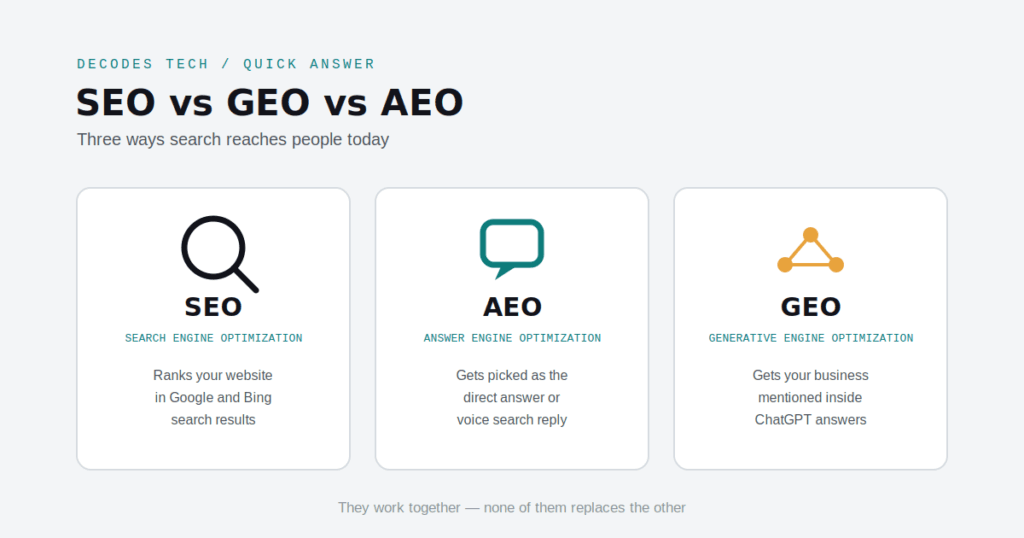
If you’ve been reading marketing pages lately, you’ve probably run into these three confusing acronyms. Half the blogs online treat SEO vs GEO vs AEO like a new battle you must win immediately or get left behind. That’s not true, and it’s not helpful.
Here’s the honest version: these are three different ways search results reach people today. Understanding the difference matters because Google, ChatGPT, and Perplexity now show information in different formats, not because there’s a new secret formula.
Let’s go through what each one really is, without the hype.
SEO (Search Engine Optimization), The One You Already Know
SEO is the practice of getting your website to show up when someone types a query into Google or Bing. It’s been around for close to three decades and it’s still the foundation everything else is built on.
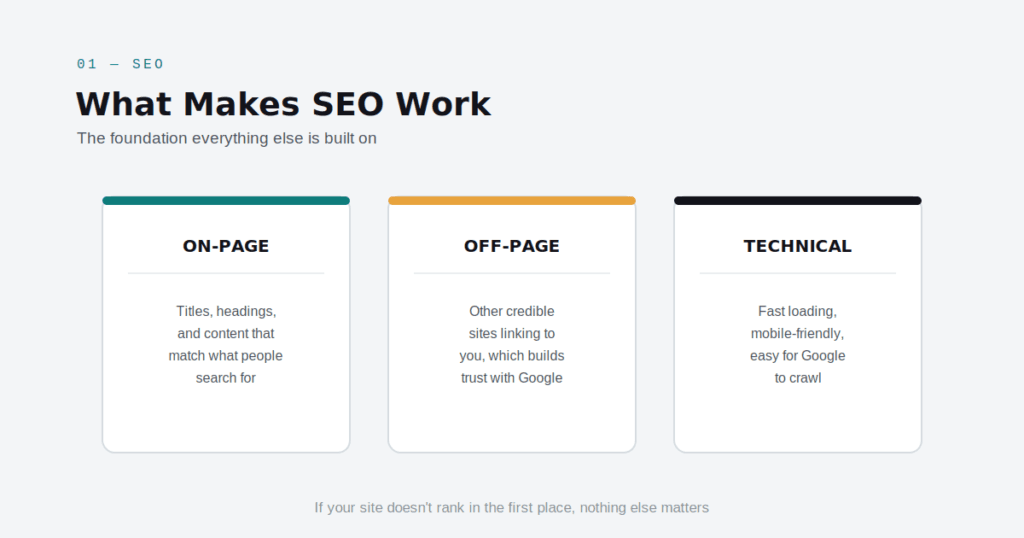
SEO works through:
- On-page signals : your titles, headings, and content actually matching what people search for
- Off-page signals : other credible websites linking to you, which tells Google your site is trustworthy
- Technical health : your site loading fast, working on mobile, and being easy for Google to crawl
If your site doesn’t rank in the first place, nothing else on this list matters. AEO and GEO don’t replace SEO. They sit on top of it. If your current marketing already feels like it isn’t working, it’s worth reading through common digital marketing problems and how to actually fix them before layering new strategies on top.
AEO (Answer Engine Optimization), Getting Picked as the Direct Answer
AEO is about being the answer, not just a link in the list. When someone searches “what is local SEO” and Google shows a box at the top with a short answer, before any of the ten blue links, that box came from a page optimized for AEO.
This also covers voice search: when someone asks Siri or Google Assistant a question and gets one spoken answer instead of a list of options.
Google itself confirms that AI Overviews and AI Mode pull from a wider, more diverse set of supporting web pages than a classic search result, and that these features only appear when the system decides they genuinely add value over a normal result page.
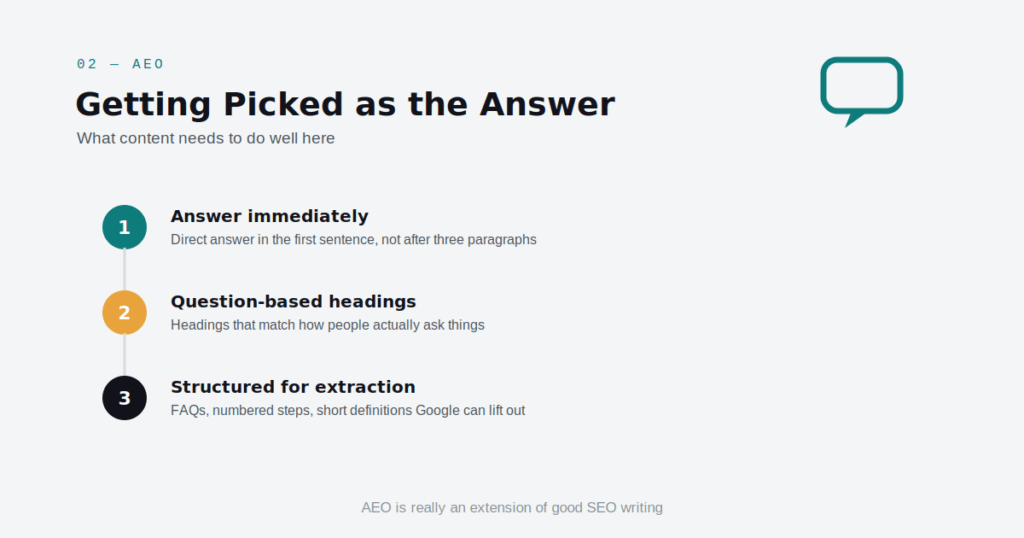
To do well here, content needs to:
- Answer the question directly in the first sentence or two, not after three paragraphs of introduction
- Use clear, question-based headings that match how people actually ask things
- Be structured with FAQs, numbered steps, or short definitions Google can lift out easily
AEO is really an extension of good SEO writing. It just rewards clarity and directness over length.
GEO (Generative Engine Optimization), Getting Cited Inside AI Answers
GEO is the newest of the three, and it works differently from the other two. This is about how tools like ChatGPT, Google’s AI Overviews, and Perplexity decide what to say when someone asks them a question, and whether your business gets mentioned in that answer at all.
If you want a closer look at how these tools are already changing day-to-day operations, we’ve covered that separately in AI Agents for Modern Business.
The tricky part: there’s no results page to rank on. The AI reads across many sources, forms one answer, and sometimes names a source, sometimes doesn’t. There’s no guaranteed traffic even if you’re cited, since the user may never click through.
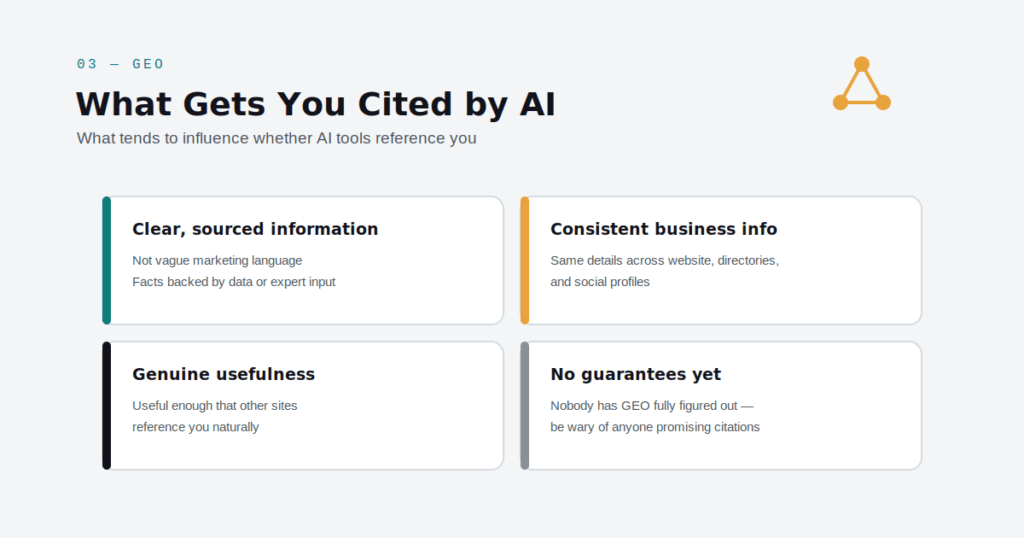
What tends to influence whether AI systems reference your content:
- Clear, well-sourced information instead of vague marketing language
- Facts stated plainly, backed by data or expert input
- Consistency: if your business’s information (services, pricing, expertise) reads the same way across your website, directories, and social profiles, AI systems are more likely to trust and repeat it
- Being genuinely useful enough that other sites reference you, which builds the same kind of authority AI models pick up on
Nobody, including large agencies claiming “GEO certified” status, has this fully figured out yet. Anyone promising guaranteed AI citations is overselling it. Google’s own developer guidance warns site owners to be cautious of third-party tools that claim to use “internal” Google ranking or AI metrics, since no outside tool actually has access to those systems.
The term itself is a fairly recent addition to marketing vocabulary. Wikipedia’s entry on Generative Engine Optimization traces it back to generative AI being built directly into mainstream search and information tools.
A Quick Example of How This Plays Out
Say someone owns a small clinic in Lahore. A patient searching “dentist near me open now” is a pure SEO and local search problem: the clinic needs to rank on Google Maps and in local results. That same patient asking Google “how much does a root canal usually cost” might get an AI Overview built from AEO-friendly content: short, structured answers from clinics and health sites. But almost nobody is asking ChatGPT “which dentist should I visit in Lahore” yet, so GEO barely matters here.
Now flip it: a software company selling inventory management tools has buyers who increasingly ask ChatGPT or Perplexity “what’s the best inventory software for a mid size retailer” before they ever type into Google. For that business, GEO is not optional. It’s becoming one of the first places buyers actually meet the brand.
Same three acronyms, completely different priority, depending on how the business’s actual customers search.
SEO vs GEO vs AEO: The Real Comparison
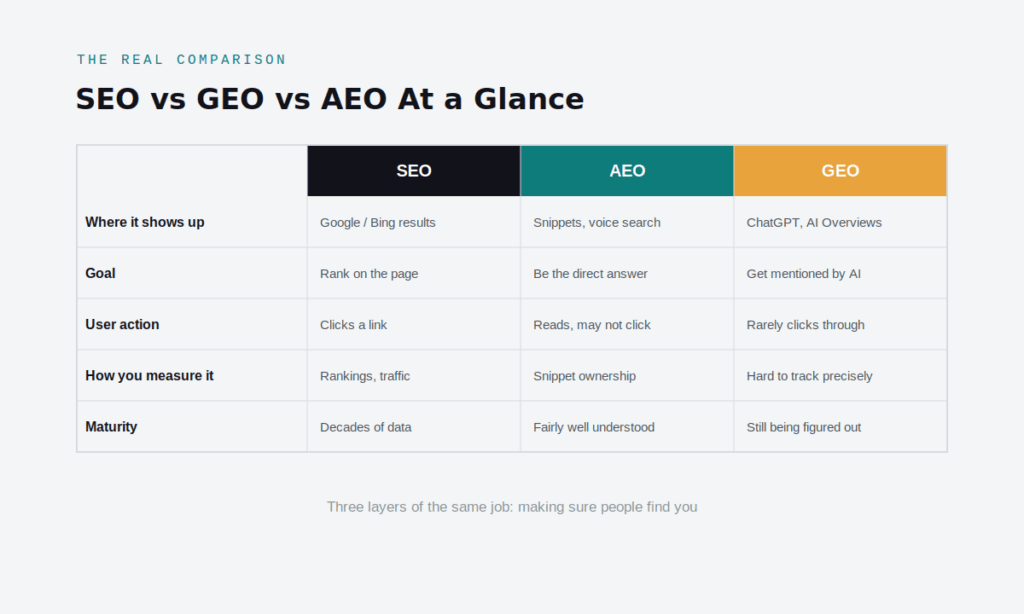
| SEO | AEO | GEO | |
|---|---|---|---|
| Where it shows up | Google/Bing search results | Featured snippets, voice assistants | ChatGPT, AI Overviews, Perplexity |
| Goal | Rank on the page | Get picked as the direct answer | Get mentioned inside an AI-generated response |
| User action | Clicks a link | Reads the answer, may or may not click | Reads the AI’s answer, rarely clicks |
| How you measure it | Rankings, organic traffic | Snippet ownership, voice answer share | Mentions in AI tools (hard to track precisely) |
| How mature it is | Well understood, decades of data | Fairly well understood | Still being figured out by everyone |
Do You Actually Need All Three?
It depends on your business, and anyone telling you every business needs an aggressive GEO strategy right now is guessing.
If you’re a local business : a clinic, a restaurant, a service provider, SEO and basic AEO will do more for you than chasing AI citations that don’t send traffic anyway.
If you’re a B2B company, SaaS product, or anyone selling to people who research before buying, GEO deserves attention now, because those buyers are increasingly asking AI tools “what solves X problem” before they ever open Google.
If you don’t have solid SEO yet, skip GEO conversations entirely for now. AI tools mostly pull from content that already ranks well and looks credible. Chasing GEO before your website is properly indexed and structured is building on sand.
If you’re not sure where your business currently stands, that’s worth a proper conversation with someone who handles digital marketing day to day before committing budget to any new strategy.
What To Actually Do About This
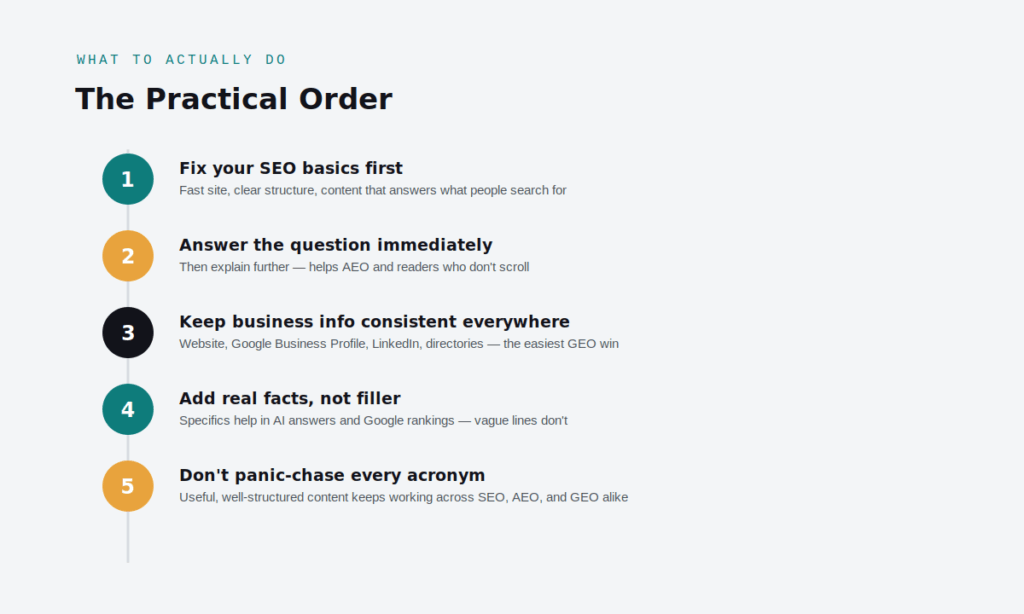
No fluff. Here’s the practical order:
- Fix your SEO basics first. Fast site, clear structure, content that actually answers what people search for. This is still most of the work.
- Write content that answers the question immediately, then explain further. This helps AEO and helps normal readers who don’t want to scroll.
- Keep your business information consistent everywhere, your website, Google Business Profile, LinkedIn, directory listings. This is the single easiest GEO improvement most businesses skip.
- Add real facts, not filler. Lines like “we provide the best services” don’t help you in AI answers or in Google rankings. Specifics do.
- Don’t panic-chase every new acronym. SEO, AEO, and GEO will keep evolving. Solid, well-structured content keeps working across all three, because all three ultimately reward the same thing: being genuinely useful and easy to understand.
If any of this feels overdue on your own site, worth checking whether you’re making any of these common digital marketing mistakes first.
Frequently Asked Questions
Is GEO replacing SEO?
How do I optimize my website for ChatGPT and Google AI Overviews?
Do I need to hire a separate agency for GEO?
How long does it take to see results from SEO, AEO, or GEO?
Should a small business worry about GEO right now?
What is the difference between SEO, AEO, and GEO in one line each?
Related Reads
- How to Choose the Best Digital Marketing Agency in Pakistan
- WordPress vs Custom Website , Which One Should You Actually Choose
- WooCommerce vs Shopify , Which Ecommerce Platform Is Actually Worth It
- Google Ads vs Meta Ads , Which Is Better for Your Business
- What’s the Difference Between UI and UX Design
- How AI Is Changing Business
How DeCodeS Tech Can Help
Getting the SEO, AEO, and GEO basics right isn’t a one-person job. Depending on where your business needs the most work:
- Digital Marketing : SEO, content, and campaign strategy built on the fundamentals covered in this post
- Website Development : fixing the speed, structure, and crawlability issues that hold SEO and AEO back
- UX/UI Design : making sure your content and site structure is actually easy for people, and search engines, to use
- All Our Services : the full picture of what we do
If you’d rather just talk it through, get in touch with us directly.