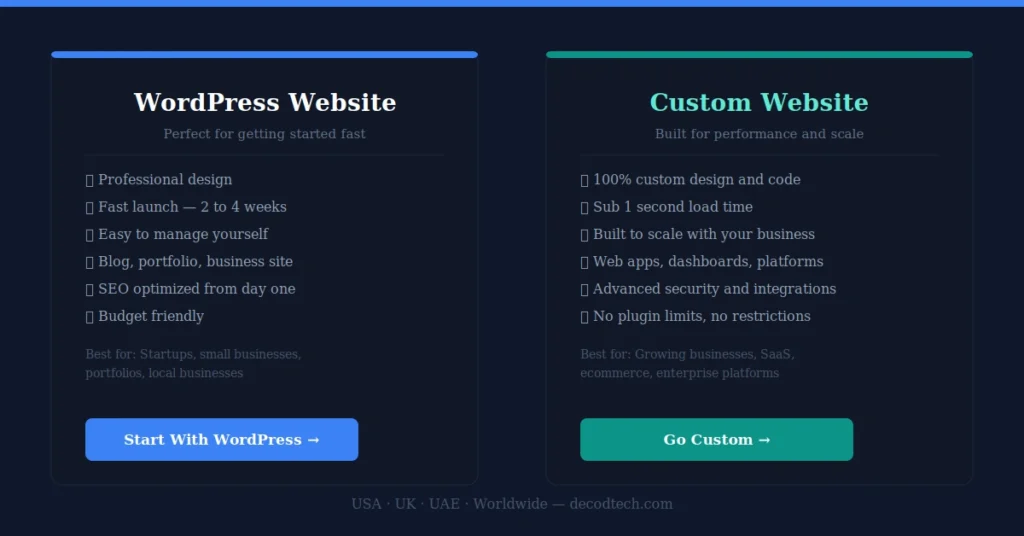
Most businesses choose WordPress because it’s the default. If you’re trying to decide on a wordpress vs custom website for business, you’re already asking the right question. It’s fast to launch, cheap to start, and there are approximately 80,000 plugins that promise to solve every problem you’ll ever have.
Then six months later, the site’s slow. Something broke after an update. The developer who built it is gone. And now you’re Googling “why is my WordPress site getting hacked.”
Sound familiar? You’re not alone. The WordPress vs custom website for business, debate isn’t really about technology, it’s about what stage your business is at, what you actually need, and what the real cost of the wrong decision looks like. Let’s cut through the noise.
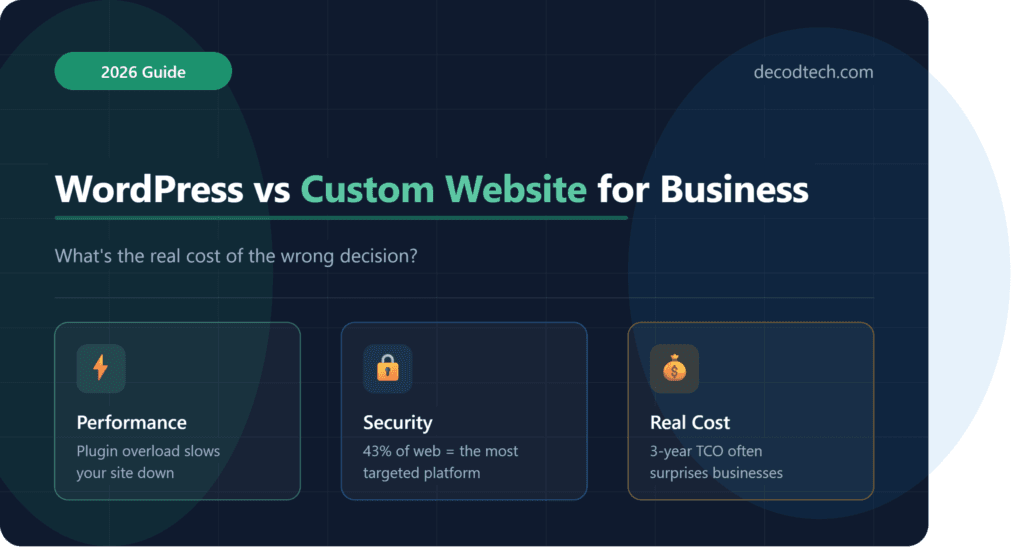
WordPress vs Custom Website for Business : What’s Really Being Compared?
WordPress is a CMS (Content Management System). It was built to publish blog content, and it’s gotten really good at doing a lot more than that. It powers around 43% of all websites on the internet, which is impressive and also slightly terrifying, because that makes it the world’s most targeted platform for security exploits.
A custom website, on the other hand, is built from scratch (or with modern frameworks like React, Next.js, or Laravel) specifically for your business requirements. No pre built assumptions. No plugin dependencies. Just code that does exactly what you need it to do.
Both are legitimate options. The problem is that most people pick one without understanding what they’re actually signing up for long-term.
The Real WordPress vs Custom Development Cost Breakdown in 2026
Here’s where it gets interesting and where a lot of businesses get burned.
WordPress upfront costs look affordable: a theme might run $50–$200, premium plugins $20–$200/year each, and basic setup anywhere from $500 to $5,000 depending on who builds it.
Custom website upfront costs are higher, typically $5,000–$30,000+ depending on complexity.
But look at the 3-year picture:
| Cost Factor | WordPress | Custom Website |
|---|---|---|
| Initial build | $1,000–$8,000 | $8,000–$30,000 |
| Plugin licenses (annual) | $500–$3,000 | $0 |
| Security patches & maintenance | $1,200–$4,800 | $600–$2,400 |
| Performance fixes | $500–$2,000 | Minimal |
| Developer dependency | High | Moderate |
| Rebuild cost (if outgrown) | Full rebuild | Incremental |
Custom website maintenance cost vs WordPress over 3–5 years often ends up comparable, sometimes cheaper ,once you factor in plugin overload problems, emergency fix costs, and the inevitable moment you need to rebuild because WordPress simply can’t scale to where your business has grown.
When you’re making a WordPress vs custom website for business decision based purely on the initial invoice, you’re looking at the wrong number.
Custom website vs WordPress ROI isn’t just about money. It’s about what you lose in speed, performance, and customer experience when your website is held together with plugins.
WordPress Performance vs Custom Website: The Numbers Don’t Lie
WordPress plugin overload problems are real. When comparing wordpress vs custom website for business performance, the numbers don’t lie. The average WordPress site runs 20–30 plugins. Each one adds HTTP requests, database queries, and JavaScript to your page. The result? A site that passes Core Web Vitals on a good day and fails on a slow one.
Custom website load time is significantly faster because there’s no CMS overhead, no plugin bloat, and no generic theme code. A well-built custom site regularly hits sub-2-second load times without heroics.
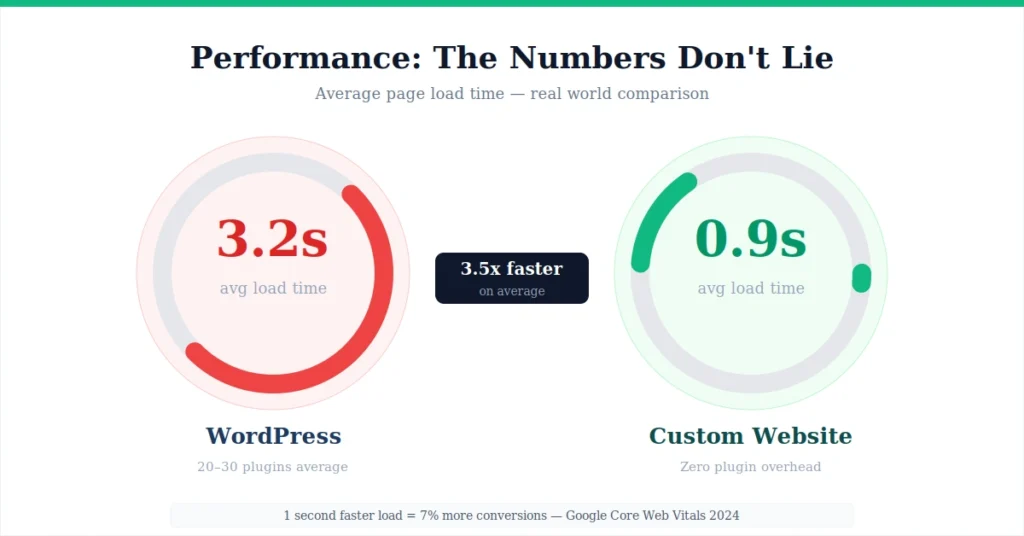
Does this matter for SEO? Absolutely. Custom website vs WordPress SEO isn’t just about meta tags Google’s ranking signals include page experience, Core Web Vitals, and mobile performance. A bloated WordPress site with 4.2-second load time will lose rankings to a lean custom site every time, regardless of content quality.
If you’re running paid ads, a 1-second improvement in load time can increase conversions by 7%. That’s not just a WordPress vs custom website for business preference that’s a revenue conversation.
WordPress Security Issues: The Elephant in the Room
Let’s be direct about this. WordPress security issues aren’t hypothetical they’re the most common cause of website breaches for small and mid size businesses.For any wordpress vs custom website for business decision, security is the elephant in the room.
Because WordPress is so widely used, it’s the most actively attacked CMS on the planet. Vulnerabilities in themes, plugins, and outdated core versions are exploited constantly by automated bots. In 2023, over 90% of hacked CMS sites were running WordPress.
Custom websites aren’t immune to security issues but they’re not a mass target. A custom-built site has no publicly known attack surface. There’s no plugin with a known CVE waiting to be exploited. The attack vector that hits 500,000 WordPress sites simultaneously simply doesn’t apply.
For businesses handling customer data, payments, or sensitive information, this isn’t a minor consideration. It’s a liability question.
WordPress Scalability vs Custom: When WordPress Starts to Crack
WordPress scalability becomes a genuine problem around the 50,000–100,000 monthly visitor mark or earlier if you’re running complex queries, user accounts, or dynamic content.
The database structure WordPress uses was designed for blog posts. It works fine at small scale. But as traffic grows, you start hitting slow queries, caching headaches, and infrastructure costs that balloon to compensate for architectural inefficiency.
Custom websites can be designed with scalability built in from day one. The architecture choices microservices, serverless functions, optimized databases can be made based on actual traffic patterns rather than retrofitted around WordPress’s assumptions.
If you’re building something that you genuinely expect to grow, the WordPress vs custom website for business choice at the startup stage has long-term consequences. Building on WordPress for speed-to-market is valid. Planning to stay on it indefinitely because “it’s working” is where businesses get caught.
When to Switch From WordPress to Custom Website
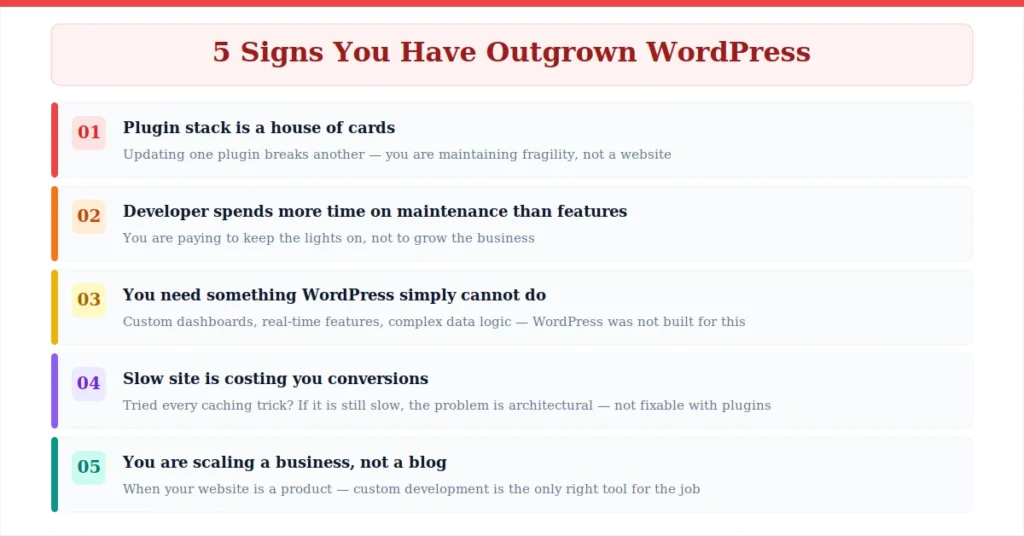
Here are the honest signals that you’ve outgrown WordPress:
1. Your plugin stack is a house of cards. If updating one plugin breaks another, you’re maintaining a fragile system, not a website.
2. Your developer spends more time on maintenance than features. WordPress maintenance work isn’t improving your product it’s keeping it alive.
3. You need something WordPress simply can’t do. Custom user dashboards, real time features, complex data relationships these all require wrestling WordPress into shapes it wasn’t designed for.
4. Performance is costing you conversions. If your site is slow and you’ve tried every caching plugin and CDN trick, the problem is architectural.
5. You’re scaling a business, not a blog. There’s a point where your website is a product, not a brochure and custom development is the right tool for building products.
What About Headless WordPress in 2026?
Headless WordPress 2026 is the middle path web development 2026 that some businesses are exploring using WordPress purely as a backend CMS while serving the frontend through a modern framework like Next.js.
It’s a legitimate architecture. You get the familiar WordPress editing experience for content teams while gaining the performance and flexibility of a custom frontend. But it’s not simple to build or maintain, and it requires developers who understand both WordPress internals and modern JavaScript frameworks.
For most small businesses, it’s overkill. For larger content-driven sites that genuinely need a non-technical CMS interface, it can be a smart compromise.
WordPress vs Custom Website Ecommerce: A Special Case
WordPress vs custom website ecommerce deserves its own mention and for online stores, the WordPress vs custom website for business stakes are even higher because your checkout experience directly affects revenue. WooCommerce is powerful, well-supported, and genuinely handles a lot of ecommerce use cases well. For a store with 50–500 products and straightforward checkout flows, WooCommerce is a solid choice.
But as you add product variations, subscriptions, multi-currency, custom checkout logic, or high transaction volume WooCommerce’s performance and architectural limitations surface quickly. Custom ecommerce builds (or platforms like Shopify with custom frontend) give you control over every touchpoint in the purchase experience.
Conversion rate optimization at scale requires that level of control. A 1% improvement in checkout conversion on a $500K/year store is $5,000. The economics of custom development change quickly once you start thinking in those terms.
So, Which One Should You Choose?
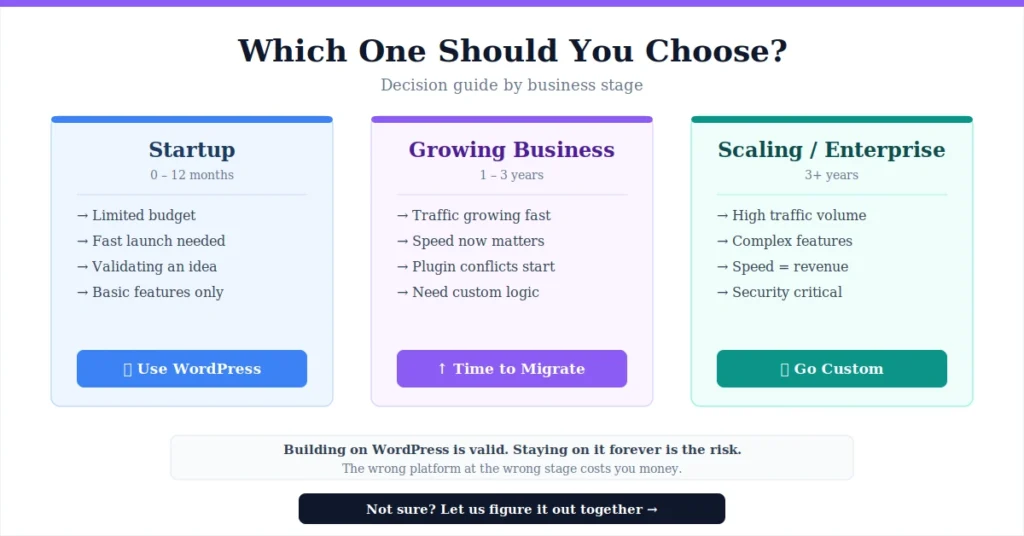
Choose WordPress if:
- You’re launching fast with a limited budget
- You primarily need a content/blog site or basic brochure site
- You have in-house staff comfortable managing WordPress
- Your feature needs are met by existing plugins without excessive stacking
- You’re validating a concept before investing in custom development
Choose a custom website if:
- Your business has complex or unique functionality requirements
- Performance and user experience are core to your product
- You’re scaling and need reliable infrastructure under load
- Security and data handling are non-negotiable (healthcare, finance, legal)
- You’re building a platform, not just a presence
WordPress website cost 2026 is low to start and accumulates over time. Custom website long term cost is higher upfront and stabilizes over time. Neither is universally better the right answer depends on what you’re actually building.
The Bottom Line
The WordPress vs custom website for business question doesn’t have a universal answer. But it does have a business specific one. The businesses that make the right choice are the ones who look past the initial build cost and think about what their website needs to do in two, three, five years and who they need it to serve.
If you’re not sure which path fits your goals, that’s exactly the kind of conversation worth having with someone who builds both.
Ready to figure out the right solution for your business? DeCodeS Tech builds everything from fast, professional WordPress websites to fully custom web apps and digital products for businesses across the USA, UK, UAE, and worldwide. Whether you need a clean site up quickly or a custom engineered platform built to scale, we’ll help you make the right call and build it properly.
Visit decodtech.com to start the conversation.