
Running a small business means every rupee you spend on advertising has to earn its place. So when someone tells you to run Google Ads, and someone else swears by Facebook and Instagram, and you only have budget for one the stakes are real.
I’ve watched small businesses burn through months of ad budget on Google when their customers were scrolling Instagram the whole time. I’ve also seen product brands pour money into Meta and wonder why sales aren’t coming only to discover their buyers were actively Googling and ready to purchase. The platform was never the problem. The mismatch was.
This guide breaks down Google Ads vs Meta Ads properly. Not surface-level comparisons real numbers, honest trade offs, and a clear answer based on what your business actually looks like.
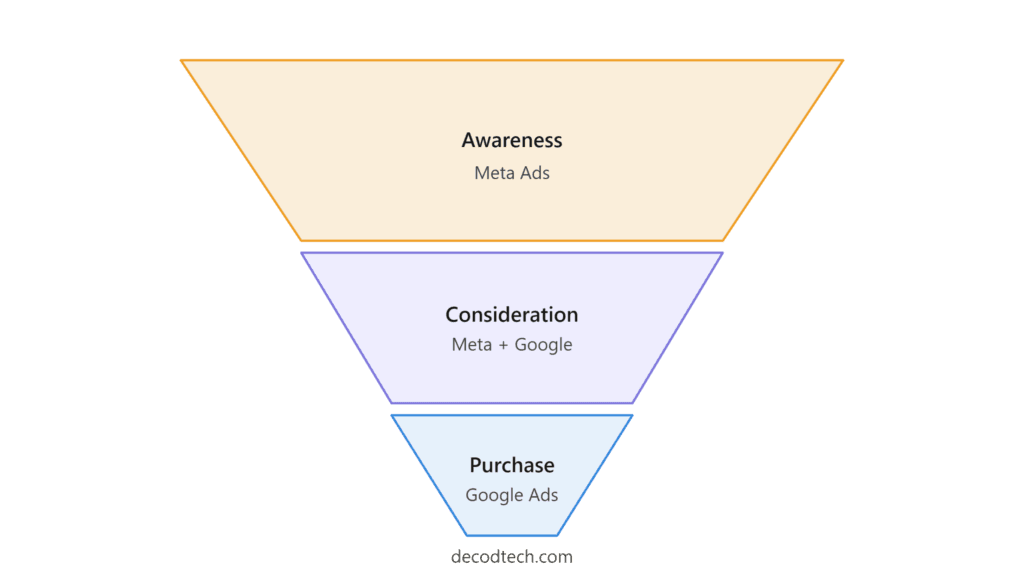
The Difference That Changes Everything
Most comparisons jump to CPC tables before explaining why the platforms work completely differently at a fundamental level. Get this wrong and no benchmark in the world will help you.
Google Ads catches people who are already looking.
Someone types “digital marketing agency in Pakistan” or “web designer near me” into Google. That person has identified a problem, decided to solve it, and is actively searching right now. You don’t need to convince them they need something you just have to show up as the right choice at that moment.
Meta Ads reaches people before they start looking.
That same person is on Instagram between meetings, not thinking about a web designer at all. Your ad slides into their feed, catches their attention, and plants a thought. Maybe they click today. Maybe they think about it for a week and then Google your name. The path to sale is longer, but the audience you can reach is vastly bigger.
Neither is better. They operate at different points in how real people actually make decisions. That’s the entire framework. Everything else budgets, creative, timelines, platform choice flows from understanding this one distinction.
Google Ads in 2026
Google Ads places your ads across Search, YouTube, Gmail, and the Google Display Network. For most small businesses, Search campaigns are where the value is your ad appears when someone types a keyword you’re bidding on.
The platform runs on intent based bidding. You choose which searches you want to appear for, set how much you’re willing to pay per click, and Google factors in your bid alongside your Quality Score basically how relevant your ad and landing page are to what someone searched to decide whether your ad runs and where.
In 2026, Google has been pushing Performance Max campaigns hard. PMax runs across all Google inventory at once and lets their AI determine placements automatically. It sounds simple, but it needs real conversion data to perform properly. Google’s own documentation notes it requires 30–50 conversions per month before the algorithm genuinely learns what works. (Google Ads Help: About Performance Max) For a small business starting out, a focused Search campaign gives you more control and clearer results.
Google Ads Cost Data 2026
These figures come from WordStream and LocaliQ’s benchmark report covering 16,000+ real campaigns (April 2024 – March 2025) the most cited industry benchmark available. (WordStream Google Ads Benchmarks 2025)
| Metric | Industry Average |
|---|---|
| Average CPC — Search | $2.69 – $5.26 |
| Average CTR — Search | 6.11% |
| Average Conversion Rate | 7.52% |
| Average Cost Per Lead | $70.11 |
The range on CPC is wide because industry drives everything. Legal services average $8.58 per click. Dentistry and home improvement hover around $7.85. Arts and entertainment sits at $1.60. E-commerce is $1.16 to $1.88.
Important note: These are US based benchmarks. Businesses in Pakistan and most of South Asia pay meaningfully less for the same keywords because advertiser competition is lower. Your actual CPC depends on your location, your industry, your campaign structure, and your Quality Score.
What Google Ads Does Well
The clearest advantage is intent. A person searching “affordable SEO agency Pakistan” has already decided they need one. They’re not browsing they’re evaluating. That’s a fundamentally different starting point than someone who just saw an ad on Instagram.
This makes Google especially effective for local service businesses. Someone in Dera Ghazi Khan searching “digital marketing agency near me” wants to hire someone, probably this week. For professional services consultants, agencies, clinics, contractors where a single client relationship is worth serious money, even Google’s higher CPC pays off quickly.
Google also works well for anything urgent or high intent: someone who needs a web development team for a live project, a business owner who realized they need a proper website before an event, a brand looking for graphic design services for a deadline. These are searchers with momentum, and Google puts you in front of them at exactly the right moment.
If you’re curious how our digital marketing services fit into a paid advertising strategy, that page gives you the full picture.
Where Google Ads Falls Short
It’s expensive to get wrong. A campaign with broad keywords, weak ad copy, and a homepage as the landing page will burn through budget in days. The platform genuinely rewards people who understand keyword match types, Quality Scores, negative keywords, and bid strategies. Poorly built campaigns are one of the most common digital marketing mistakes small businesses make.
It also can’t create demand that doesn’t exist. New products that nobody has heard of have no search volume. If people aren’t typing for what you sell, there are no searches to capture. That’s not a Google problem it’s just the nature of intent-based advertising.
Meta Ads in 2026
Meta Ads runs across Facebook, Instagram, Messenger, and the Meta Audience Network. Nobody on these platforms is searching for anything they’re scrolling through content, watching Reels, checking what their contacts are up to. Your ad shows up in that flow and has to earn their attention without the advantage of them already looking for you.
What Meta has instead of intent is audience data. Years of behavioral signals across billions of users means Meta can identify people who match your customer profile with remarkable precision their interests, shopping habits, demographics, the pages they follow, what they’ve bought recently. You can reach people who’ve never heard of you but look exactly like your best existing customers.
In 2026, Meta’s Advantage+ AI system handles much of the audience targeting and optimization that advertisers used to manage manually. Advantage+ Shopping Campaigns grew 70% year over year in Q4 2024, which signals how much the advertising industry has shifted toward letting Meta’s algorithm do the heavy lifting. (Meta Q4 2024 Earnings)
Meta Ads Cost Data 2026
These figures are drawn from AdAmigo’s 2026 Meta Ads benchmark report and Pixel Movers’ portfolio analysis across 15+ active accounts managing over $2 million in annual spend including accounts in Pakistan, UAE, the US, and the UK. (AdAmigo Meta Ads Conversion Benchmarks 2026) (Pixel Movers ROAS Benchmarks 2026)
| Metric | Average |
|---|---|
| Average CPC, Traffic Campaigns | $0.70 – $0.97 |
| Average CTR | 2.0% |
| Lead Gen Campaign CTR | 2.59% |
| Average Cost Per Lead | $23.10 – $27.66 |
| Average ROAS, All Industries | 2.19x |
| Average ROAS, E-commerce | 2.87x |
| Top Quartile E-commerce ROAS | 4x+ |
The lower ROAS average compared to Google is not a weakness it reflects where Meta sits in the buying journey. Meta primarily operates at the awareness and consideration stages, not at the point of purchase. Retargeting campaigns on Meta, where you’re re-engaging people who already visited your site, regularly reach 6x to 15x ROAS because that audience already knows who you are. (Zentric Digital ROAS Benchmarks 2026)
One more thing on ROAS worth saying plainly: the number alone tells you very little without knowing your margins. A 2.5x ROAS on a 70% gross margin product is genuinely profitable. A 5x ROAS on a 15% margin product might barely break even. Know your break-even ROAS before judging any campaign. (Stephen Ellul: Good ROAS for Meta Ads 2026)
What Meta Ads Does Well
Cost per click is genuinely lower. At $0.70 to $0.97 average for traffic campaigns versus $2.69 to $5.26 on Google Search, Meta stretches the same budget into far more impressions and clicks. For brand awareness, product discovery, and building an audience, that efficiency is hard to match.
Visual products are a natural fit. Fashion, food, home goods, beauty, tech accessories, anything that looks compelling in a photo or short video performs well on feeds and Reels. People discover products on social media in a way they simply don’t on search engines. Good graphic design and strong creative are the engine that makes Meta campaigns run.
Lookalike audiences work. Upload a list of your 200 best customers and Meta finds millions of people who share the same behavioral patterns. It’s one of the most effective scaling mechanisms in paid advertising and something that has no real equivalent on Google.
Retargeting is cheap and works well. Someone visited your site but didn’t convert. A reminder ad on Instagram the next day, at Meta’s lower CPCs, reaches a warm audience that already knows you exist. Combined with strong UI/UX design on your landing pages, retargeting campaigns consistently show high conversion rates relative to cold traffic.
Where Meta Ads Falls Short
The intent gap is real. Getting someone to notice your ad mid-scroll, process the message, feel interested enough to click, and then actually buy something is a longer journey than Google where they typed in exactly what they want. Meta requires patience, more creative testing, and a realistic timeline.
Creative quality has an outsized impact on results. A mediocre search ad still shows up for the right keyword. A mediocre Meta ad gets scrolled past in under a second. The first frame of a video, the headline, the image these determine whether a campaign works or fails. Many businesses underinvest in creative and then blame the platform. If you’re not producing quality short-form video and strong visuals, Meta will underperform regardless of your targeting settings. (Around29 Digital: Google Ads vs Meta Ads ROI 2026)
iOS privacy changes have also made attribution messier. Meta likely drives more conversions than your dashboard shows, because some iOS users can’t be tracked across apps. This means Meta’s contribution to your sales is often underreported, which makes the platform look less effective than it actually is.
Google Ads vs Meta Ads: Direct Comparison
| Factor | Google Ads | Meta Ads |
|---|---|---|
| What triggers your ad | Someone searching for a solution | Someone matching your audience profile |
| Average CPC (US benchmark) | $2.69 – $5.26 | $0.70 – $0.97 |
| Average conversion rate | 7.52% | 0.9% – 2.0% |
| Average blended ROAS | 3.31x – 4.2x | 2.19x all / 2.87x e-commerce |
| Where in the funnel | Bottom, ready to buy | Top and middle, discover and consider |
| Ad format | Text-based search ads | Video, Reels, images, carousels |
| How targeting works | Keywords and search intent | Demographics, interests, behavior |
| Speed to see results | Days to a few weeks | Weeks to months |
| Works best for | Services, B2B, local businesses | Products, e-commerce, new brands |
| Realistic minimum budget | $1,000+/month (competitive) | $500+/month (enough to learn) |
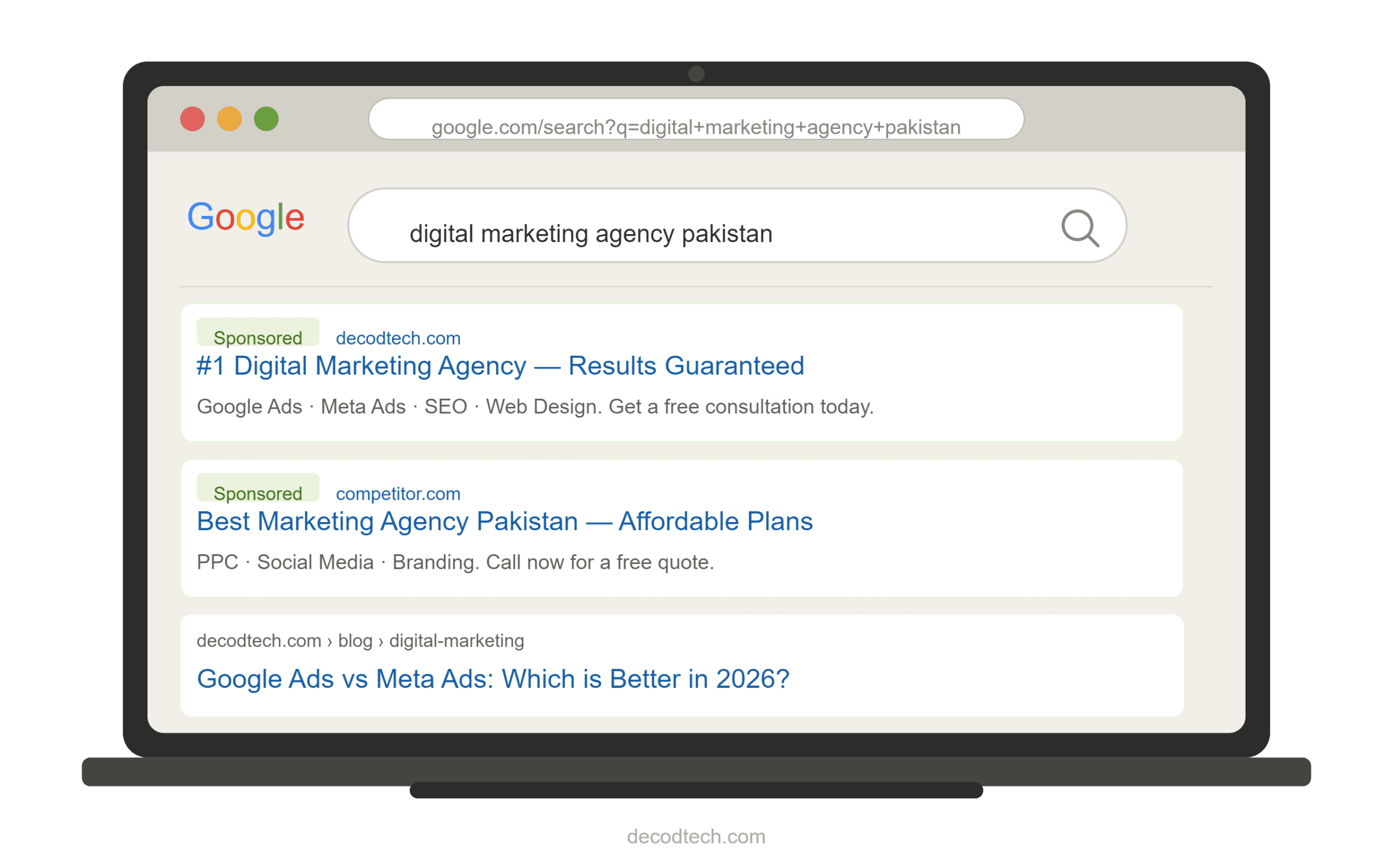
CPC benchmarks are US-based. Costs in Pakistan and neighboring markets are typically lower. See the sources below for full industry breakdowns.
Which Platform Should Your Business Use?
Local service business, agency, clinic, salon, contractor
Start with Google Ads. When someone in your city searches for the service you provide, they want to hire someone soon. A focused Search campaign targeting your location plus a handful of high intent keywords can generate quality leads even on a modest budget. Once Google is running and you have conversion data, add Meta retargeting to re engage site visitors who didn’t reach out the first time. (511 Digital Marketing: Meta Ads vs Google Ads 2026)
DeCodeS Tech offers web development services purpose-built for service businesses the kind of landing pages that make paid traffic convert rather than bounce.
E-commerce or visual product brand
Start with Meta Ads. Products with visual appeal fashion, home goods, beauty, gadgets get discovered on Instagram and Facebook in a way they simply don’t on search. Meta’s lower CPC also means you reach more potential buyers per dollar. Once your pixel has data and you’re generating consistent traffic, add Google Shopping campaigns to capture people who are actively searching for products like yours.
New brand launching something nobody is searching for yet
Meta Ads only, at least initially. Google captures demand that already exists if nobody is searching for your product category, there’s nothing to capture. Meta lets you reach people based on who they are and what they care about, not what they’re typing. Build awareness first on Meta, then layer in Google once searches start happening.
B2B or professional services
Google Ads for bottom funnel, Meta for retargeting and nurturing. Business buyers do their research they Google “SEO agency Pakistan” or “web design company for small business.” Capture that intent with Search campaigns. Then use Meta to stay visible to people who visited your site while they’re still comparing options, showing them case studies, testimonials, and social proof. (Scalix AI: Google Ads vs Meta Ads 2026)
Budget under $500/month
Be realistic. Both platforms need data to optimize. Google PMax wants 30–50 monthly conversions. Meta needs 50+ conversion events and 7–14 days minimum before exiting the learning phase. Under $500/month, you may not generate enough volume for either algorithm to work properly. Go narrow: one city, a handful of tightly defined keywords on Google, or a single well defined audience on Meta. Pick the channel where buying intent is clearest for your specific offer.
Why Running Both Platforms Together Works Better
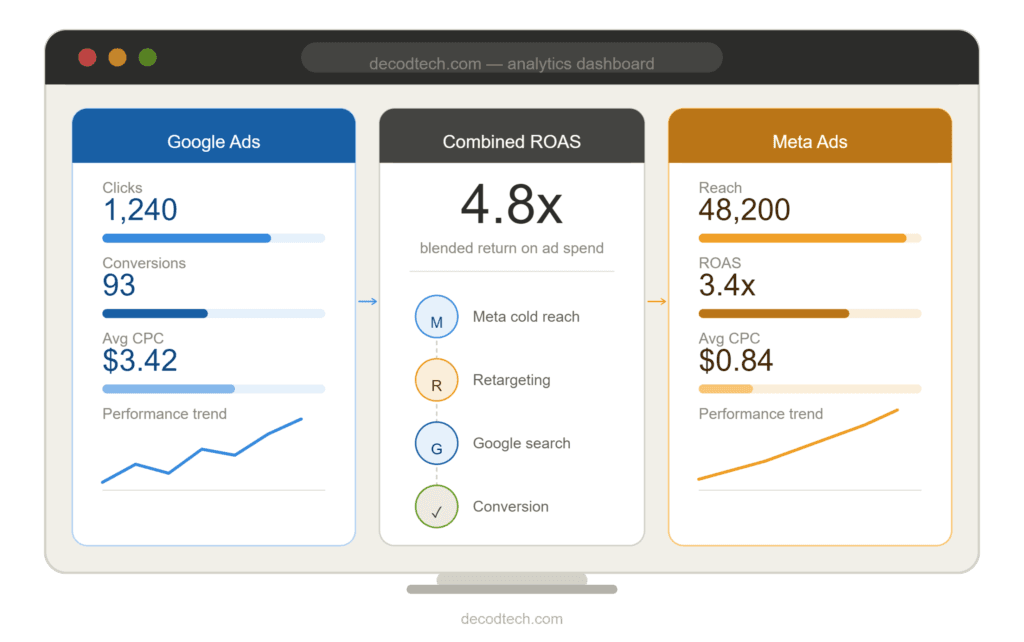
The strongest paid advertising setups in 2026 don’t choose one platform and go all in. They use both together, each doing what it’s best at, in sequence.
Here’s how it actually plays out:
Someone scrolls Instagram and sees your ad. They’re mildly interested but don’t click. Three days later they see a short video testimonial from one of your clients same brand, different creative. Now they’re curious. They Google your business name. Your branded Search campaign picks them up. They visit your website, read about your services, and fill out the contact form.
In last click attribution, Google gets all the credit. In reality, Meta started the whole journey. This is exactly why single platform attribution consistently undervalues Meta’s contribution and why the combined approach tends to outperform either platform alone. (Lemonade Digital: Google Ads vs Meta Ads Guide)
The practical flow: Meta builds awareness with cold audiences through Reels and creative content. Meta retargeting re engages the warmest visitors at low cost. Google captures the search intent that Meta exposure eventually creates. Google branded campaigns catch people searching your name directly. Each platform feeds the other.
Our digital marketing services cover both channels strategy, setup, creative, and ongoing management so you’re not running two disconnected campaigns that don’t talk to each other.
Mistakes That Waste Money on Both Platforms
Most wasted ad spend comes from a handful of fixable errors. These apply across both Google and Meta.
Sending traffic to your homepage. A homepage serves many audiences at once. An ad targets one person with one message. When those don’t match, people leave. Every campaign needs a dedicated landing page that continues exactly what the ad promised. This is one of the most common digital marketing mistakes we see, and it kills conversion rates before the algorithm has a chance to learn anything.
Too broad keywords on Google. “Marketing” and “digital marketing agency for Pakistani startups” are completely different searches. Start with phrase match or exact match. Broad match on a tight budget leads to irrelevant clicks and wasted money.
No negative keyword list. Without negatives, your Google ad shows for searches that have nothing to do with your business. Review the search terms report every week from day one and add negative keywords aggressively.
Running without conversion tracking. If you don’t know which clicks turned into leads or sales, you can’t optimize anything. Set up Google Analytics 4 and Meta Pixel before launching a single campaign. This is non negotiable.
Killing Meta campaigns in week one. Meta’s learning phase takes 7–14 days and needs 50+ conversion events to stabilize. A campaign that looks bad on day five might have been profitable by day fifteen. Judging too early wastes the budget you already spent teaching the algorithm.
Underinvesting in creative on Meta. Your targeting settings are secondary to your creative. The video hook, the headline, the opening image that’s what stops someone from scrolling. Businesses that treat creative as an afterthought consistently get mediocre Meta results, regardless of how much they spend. (Rankmehigher: Definitive Google Ads vs Meta Ads Guide 2026)
Chasing ROAS without knowing your margins. A 4x ROAS on a 20% margin product may actually lose money. A 2.5x ROAS on a 65% margin product is profitable. Calculate your break-even ROAS before evaluating any campaign’s performance. The number means nothing without that context.
What’s Actually Shifting in 2026
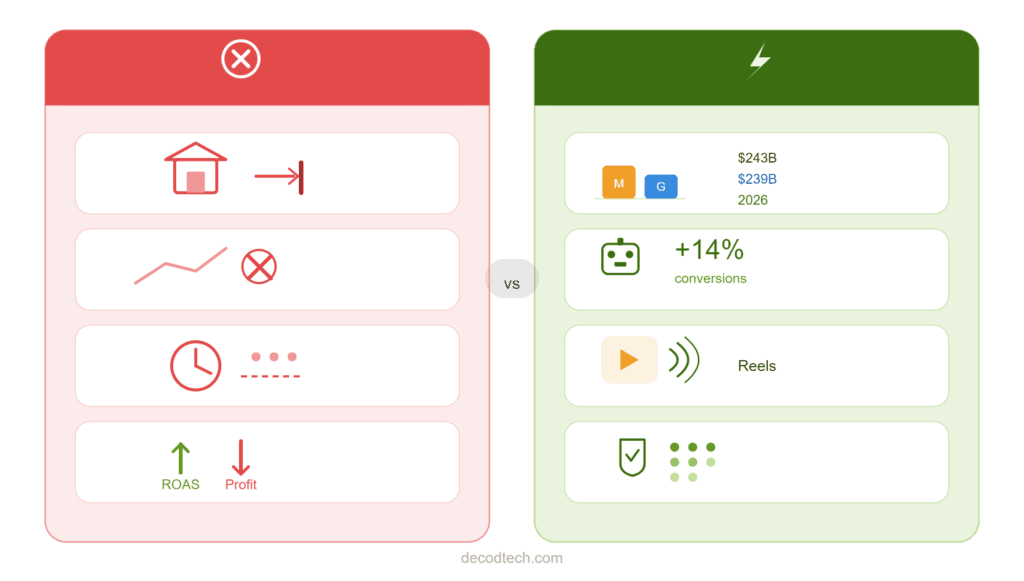
Meta is now the largest digital ad platform by revenue. According to eMarketer data published in Adweek, Meta is projected to generate $243.46 billion in global ad revenue in 2026, overtaking Google’s $239.54 billion the first time Google has been displaced from the top spot. This reflects genuine advertiser confidence in Meta’s AI-driven results. (Adweek: Meta Is Quietly Becoming a Bigger Ad Business Than Google)
Google’s AI Max for Search launched out of beta. Early results from Google showed campaigns using AI Max getting 14% more conversions at similar costs and 27% more for advertisers moving from manual exact match. (Google Blog: AI Max for Search Campaigns) Worth testing if you’re running active Search campaigns.
First-party data has become your most valuable ad asset. iOS privacy changes have reduced what platforms can track across the web. Your customer email lists, CRM data, and website visitor data are now genuinely powerful as targeting inputs on both platforms. The businesses building strong first party data now will have measurable ad performance advantages for years.
Reels are the dominant Meta format. Short-form video has taken over engagement time on Instagram and Facebook. Static images still work, but if your Meta creative strategy doesn’t include video, you’re leaving real performance behind. For help with branded video content and graphic design that actually converts, see our graphic design services.
To understand how AI is changing digital advertising in 2026 more broadly programmatic buying, algorithm driven campaigns, first-party data that post goes deeper into the full picture.
The Short Answer
Google Ads: Your customers are actively searching. You need leads relatively fast. You’re a local service business, B2B company, or professional services firm. Your offer is high value enough to justify the higher CPC.
Meta Ads: Your product benefits from visual discovery. You’re building a brand from scratch. Nobody is searching for your category yet. You want to reach a large audience at lower cost per click.
Both: You have at least $1,500/month to work with. You want a proper funnel where Meta creates demand and Google captures it. You’re building for long-term, compounding growth rather than short-term spikes.
Both platforms reward the same fundamentals: a clear offer, a proper landing page, conversion tracking set up before launch, and the patience to let campaigns generate enough data before making decisions. Getting these basics right matters more than platform choice.
See everything DeCodeS Tech offers across digital marketing, web development, design, and AI services to understand how paid advertising fits into a complete growth strategy.
Frequently Asked Questions
Is Google Ads better than Meta Ads for small business?
It depends on your business type. Google Ads works better when your customers are actively searching local services, professional services, and B2B are clear examples. Meta Ads works better when you need to create awareness, your product has visual appeal, or nobody is searching for your category yet. Many businesses benefit from running both together, with each platform doing what it does best.
How much does Google Ads cost per click in 2026?
Based on WordStream’s analysis of 16,000+ campaigns, the cross-industry average is $2.69 to $5.26 per click in US markets. Legal services and dentistry are at the high end. E-commerce and arts/entertainment are at the low end. Businesses in Pakistan typically pay less for the same keywords because there’s less advertiser competition.
What is a good ROAS for Meta Ads in 2026?
The blended average across all industries is 2.19x. E-commerce averages 2.87x, with top-performing accounts reaching 4x and above. But ROAS without margins context is misleading calculate your break-even ROAS first (divide 1 by your gross margin), then judge campaigns against that number.
Can I run Google Ads and Meta Ads at the same time?
Yes, and for most businesses with adequate budget ($1,500/month+), running both in a connected funnel outperforms either platform alone. Meta builds awareness with cold audiences; Google captures the search intent that awareness creates over time.
Which platform is better for a local business in Pakistan?
For local service businesses agencies, clinics, contractors, designers Google Ads typically delivers faster, higher quality leads because customers are actively searching for those services. Start with a tight Search campaign targeting your city and specific service keywords. Add Meta retargeting once you have Google running and want to re-engage site visitors.
How long before Google Ads or Meta Ads show results?
Google Search campaigns can generate leads within days of launch if targeting and landing pages are set up correctly. Meta campaigns need a learning phase of 7–14 days and ideally 50+ conversion events before the algorithm optimizes properly. Budget for at least 60–90 days of consistent spend before drawing firm conclusions about either platform.
Want Paid Ads That Actually Work for Your Business?
At DeCodeS Tech, we build and manage Google Ads and Meta Ads campaigns for small businesses in Pakistan and internationally. We handle everything campaign strategy, keyword research, ad copy, landing pages, conversion tracking, and ongoing optimization so your budget generates real, measurable results.