Digital Advertising in 2026 has fundamentally changed how brands reach, target, and convert customers and most advertisers haven’t caught up yet.
If you ran Google or Meta campaigns in 2022 or 2023, you remember the process.
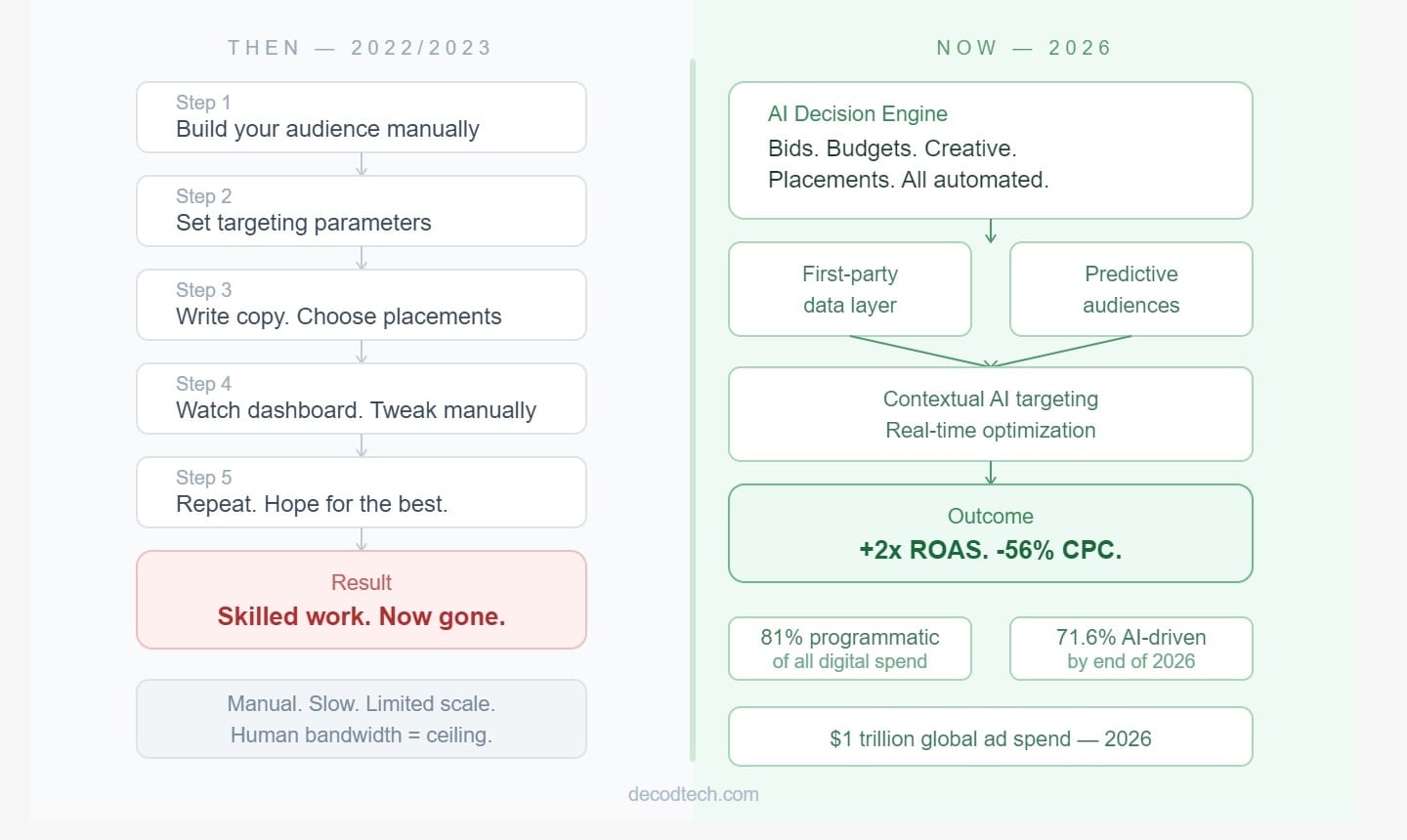
Build your audience. Set your targeting. Write your copy. Choose your placements. Watch the dashboard. Tweak manually. Repeat.
That was skilled work. And that workflow is gone.
What replaced it is not just faster it is a fundamentally different job. Digital Advertising in 2026 is not an evolution of what came before. It is a replacement.
The $1 Trillion Number, And What Digital Advertising in 2026 Actually Means
Global ad spend is on track to cross $1 trillion for the first time in 2026. That number matters not because it is big, but because of what is driving it.
Digital advertising now represents 68.7% of total spend. Programmatic trading handles more than 81% of all digital investment. And dentsu forecasts that 71.6% of ad spend will be algorithm-driven by 2026, rising to 76% by 2028.
To understand Digital Advertising in 2026, you have to understand this: an increasing majority of every advertising dollar is being directed not by a human campaign manager but by an AI decision.
What “AI-Powered Targeting” Actually Means in Digital Advertising in 2026
The Death of Identity-Based Targeting
For years, ad targeting meant finding people who matched a demographic profile. Age, location, income, interests. That approach worked reasonably well until two things happened at the same time: privacy regulations like GDPR and CCPA tightened, and third-party cookies started their decline.
The industry needed something better. It found it.
Contextual AI Replaced It & Performs Better
Forget tracking who someone is. The new approach watches what they’re doing, right now, in this moment. Reading a finance article? Watching a product review? That’s the signal. Platforms like StackAdapt call this Page Context AI, and honestly, it makes old-school demographic targeting look embarrassingly blunt.
And the results back it up. StackAdapt’s own State of Programmatic 2026 data shows advertisers leaning on first-party data are pulling 2x higher ROAS than those still chasing third-party audiences. Dynamic Creative Optimization campaigns are seeing 32% better click-through rates and costs dropping by more than half per click (56%, to be exact).
These aren’t incremental wins. This is one approach structurally outperforming another.
Predictive Audiences: AI Does Not Just Find Past Buyers
Traditional lookalike audiences were static. You uploaded a list, the platform found similar people, and you checked back later.
Here’s what’s actually interesting about 2026 predictive models they never stop working. No more uploading a list and waiting. These systems are constantly chewing through behavioral patterns, browsing history, purchase signals, and quietly flagging people who look like they’re about to buy before they’ve even decided themselves. And as new data flows in, the audience updates on its own.
Think about what that means practically. That spreadsheet of past customers you’ve been sitting on? That email list from last year’s campaign? That’s not just history anymore that’s your single most valuable advertising asset right now.
Brands who get this are compounding. Brands who don’t are basically asking the algorithm to guess. Brands with clean, well-organized customer data have a compounding advantage. Brands without it are asking AI to guess and guessing has a performance ceiling.
What Each Major Platform Has Built for Digital Advertising in 2026
These platforms are not experimenting anymore. They have shipped production tools.
Google: AI Max + Veo 3.1
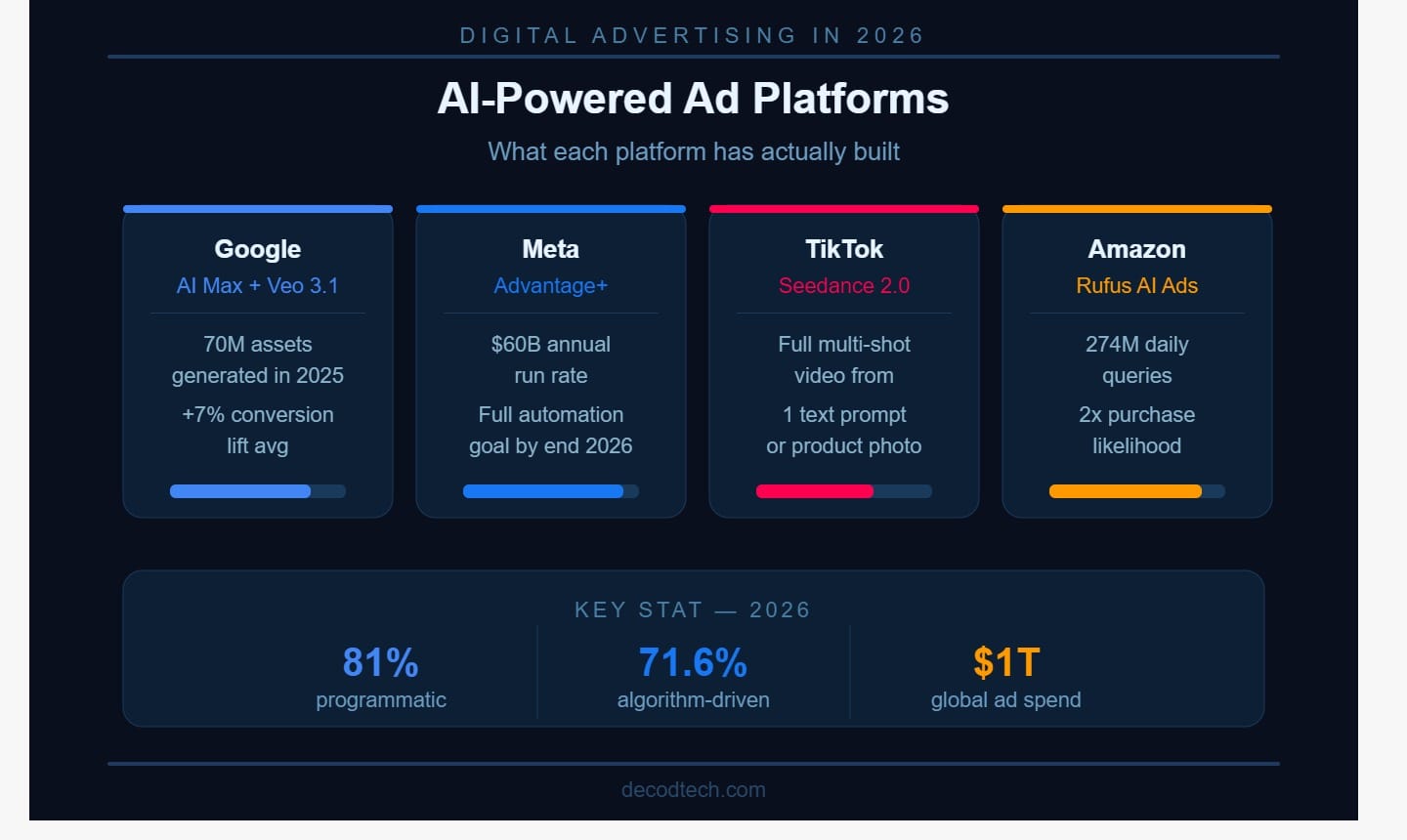
Google confirmed that in 2025, advertisers used Gemini to generate nearly 70 million creative assets inside AI Max and Performance Max campaigns a 3x year-over-year increase.
Google is also retiring Dynamic Search Ads and migrating all eligible campaigns to AI Max for Search. Starting September 2026, remaining campaigns with legacy settings will automatically upgrade whether advertisers act or not. Google’s internal data shows an average 7% lift in conversions at similar CPA/ROAS when using the full AI Max feature suite.
On the creative side, Google integrated Veo 3.1 its AI video generation model directly into the Google Ads interface. Advertisers can now generate video assets from a single text prompt or animate a static image already in their campaigns. No external production tool required.
Meta: Heading Toward Full Automation
Meta isn’t being subtle about where this is going. They’ve publicly said the goal is full end-to-end ad creation completely automated before 2026 is out. And they’re not starting from zero. Advantage+ is already doing $60 billion a year. That’s not a beta product. That’s a machine that’s already running.
What’s fueling it? Reels. AI automation. And apparently, a combination powerful enough that Meta is on track to out-earn Google in global ad revenue this year something that has never happened before.
Oh, and quietly in the background? They’ve also rolled out AI translation tools that drop voiceovers and text overlays onto your existing videos in other languages. If you’re running campaigns across multiple markets, that used to mean separate production budgets for each one. Now it doesn’t.
TikTok: Dreamina + Seedance 2.0
TikTok integrated Dreamina, powered by ByteDance’s Seedance 2.0, directly into its Symphony Creative Studio. This is not a script-generation add-on. Seedance 2.0 produces coherent multi-shot sequences a full commercial arc from product reveal to lifestyle shot to call-to-action from a single text prompt or product photo.
Amazon: Ads Inside Rufus
Amazon’s AI shopping assistant Rufus handles an estimated 274 million daily queries. On March 25, 2026, Amazon launched Sponsored Products Prompts and Sponsored Brands Prompts into general availability placing paid ads directly inside Rufus conversations when shoppers ask product-related questions. Amazon’s data shows sessions involving Rufus are twice as likely to result in a purchase.
The AI Creative Problem Nobody Is Talking About in Digital Advertising in 2026
Here is a risk that consistently gets underplayed in the generative AI creative conversation.
Smartly’s 2026 Digital Advertising Trends Report based on a survey of 450 marketing leaders worldwide found that Digital Advertising in 2026 is surfacing a new brand risk that most coverage ignores:
Three in four respondents are concerned that AI-generated creative risks making brands look and sound the same
86% had already seen AI outputs that resembled competitor content
This is a real problem. When bidding, targeting, and placement are all automated and creative is also automated differentiation disappears.
The brands winning with AI creative are not the ones generating everything automatically and shipping. They are the ones using AI for production speed while maintaining strong brand direction, creative restraint, and authentic voice.
AI handles the factory. Humans still need to design what the factory makes.
Agentic AI in Digital Advertising in 2026: What It Controls and Where It Goes Wrong
What Agentic AI Actually Does
“Let’s clear something up first”agentic AI” sounds like buzzword soup, but the actual concept is pretty straightforward. Regular AI does what you tell it. Agentic AI decides what to do next.
Give it a goal say, “cut our cost per acquisition by 20%” and it gets to work. Adjusting bids. Shifting budgets around. Testing different creative variations. Optimizing across channels. All of it, on its own, without anyone logging into a dashboard or pulling a lever. Your campaign runs, learns, and self-corrects while you’re in a completely different meeting.
That’s not automation in the old sense. That’s something closer to a junior media buyer who never sleeps and never asks for a raise.
This is not theoretical. According to eMarketer, approximately 70% of digital ad spend is now managed by agentic AI systems in some form.
How It Is Reshaping Marketing Teams
A January 2026 survey of 100 advertising leaders by Triton Digital found that AI agents are beginning to take on strategy-to-execution workflows end to end, creating direct pressure on traditional account management models. Advertisers with straightforward direct-response needs can now bypass external management entirely.
This is not a distant threat. It is already affecting how agencies structure their teams and price their services.
The Risk That Gets Missed
The brands winning with agentic AI are not the ones who handed the algorithm full control. They are the ones who built clean data infrastructure, set precise performance goals, and maintained human oversight on brand safety, compliance, and creative quality.
There is a deeper structural concern too. Organizations that automate execution entirely end up, over time, with fewer people who have deep executional knowledge. That is fine until the AI makes a systematic error. A brand safety failure at scale. An unexpected budget spike. When that happens, you need people in the room with calibrated instincts. If no one has done the work in years, those instincts are gone.
The right posture: use AI for leverage, but deliberately keep humans close enough to the execution layer that their judgment stays sharp. Not as a cost. As insurance.
First-Party Data: The Single Biggest Performance Driver in Digital Advertising in 2026
If there is one section in this post to read carefully, it is this one.
All of AI-powered advertising runs on data. As third-party cookies continue their decline and privacy regulations tighten globally, the quality of your first-party data has become the single biggest determinant of campaign performance.
Brands using predictive budgeting allocating spend based on forecasted likelihood of conversion rather than historical patterns have seen up to 25% higher ROI, according to Gartner research.
This is not a campaign-level improvement. It is a platform-level one. Getting it right requires investment in customer data platforms, consent-based data collection, and identity frameworks that can activate audiences across channels.
Zero-Click Search and AI Visibility in Digital Advertising in 2026
One trend that runs parallel to paid advertising but affects every brand running digital campaigns: the rise of AI search.
Zero-click search is no longer confined to Google. It now runs across ChatGPT, Perplexity, Gemini, Bing AI, and Meta AI. Users ask questions, receive direct answers, and frequently never visit a website.
McKinsey ran the numbers, and they’re worth stopping on. In their AI Discovery Survey, 44% of people using AI-powered search now call it their primary source of insight. Not a supplement. Not a backup. Primary. Traditional search came in at 31%. Brand websites? 9%. Review sites? A humble 6%.
So what does that actually mean if you’re running ads?
It means there’s a whole parallel channel forming one that doesn’t show up in your Google Ads dashboard. When someone asks ChatGPT or Perplexity a question in your category, your brand either shows up in that answer or it doesn’t. No bidding. No targeting. No CPC. Just are you the source that gets cited, or are you invisible?
The brands getting cited aren’t gaming anything. They’re just publishing content that AI can actually work with clear facts, a consistent voice, sources that hold up. That content drives awareness even on days when it drives zero clicks. Which, honestly, is a strange new thing to get your head around.
If you want help building content and ad strategies optimized for both AI search and paid media, DeCodeS Tech’s digital marketing team works with brands to do exactly that.
What Actually Separates Winning Campaigns from Losing Ones in Digital Advertising in 2026
It is not budget.
Marketing and sales teams that integrate AI thoughtfully are reporting revenue gains well above average consistently the highest-performing function for AI-driven revenue uplift, according to McKinsey’s 2025 State of AI report.
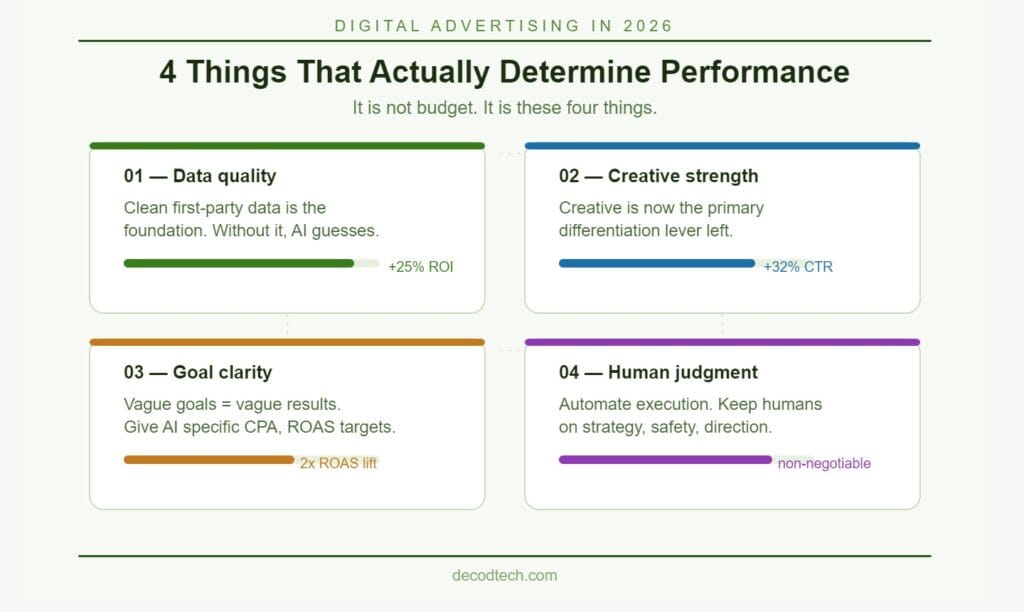
The four things that actually determine campaign performance right now:
1. Data quality. Clean, consented, well-organized first-party data is the foundation. If this is missing, AI targeting is guessing. If this is strong, AI targeting compounds.
2. Creative signal strength. As bidding and targeting are increasingly automated, creative is the primary remaining differentiation lever. Weak creative signals cannot be fixed by any bidding strategy.
3. Goal clarity. Agentic AI systems need clear, measurable objectives. Vague outcomes produce vague optimization. Specific targets CPA, ROAS, conversion rate by segment give AI systems what they need to actually optimize.
4. Human judgment at the right layer. Strategy, brand safety, creative direction, and governance are not tasks to automate. The teams winning are the ones who automate execution and focus human effort on judgment, direction, and quality control.
Where Digital Advertising in 2026 Goes from Here
AI has changed the mechanics of Digital Advertising in 2026 in ways that are structural, not cyclical. The platforms are not going back. The tools are not experimental. And the performance gap between campaigns built on clean data with strong AI integration and those running on legacy workflows is widening every quarter.
The window to build the right infrastructure first-party data, proper AI creative systems, agentic automation with human oversight is still open. It is getting narrower.
If you are running paid media and still managing campaigns the way you did in 2023, you are not just behind. You are working against systems that are getting smarter faster than manual management can keep up with.
Ready to run smarter paid media in 2026? DeCodeS Tech helps brands build AI-ready advertising infrastructure from first-party data strategy to creative systems to full campaign management. Visit decodtech.com to see how we can help.